
Lace Circular Doily Dish Rag
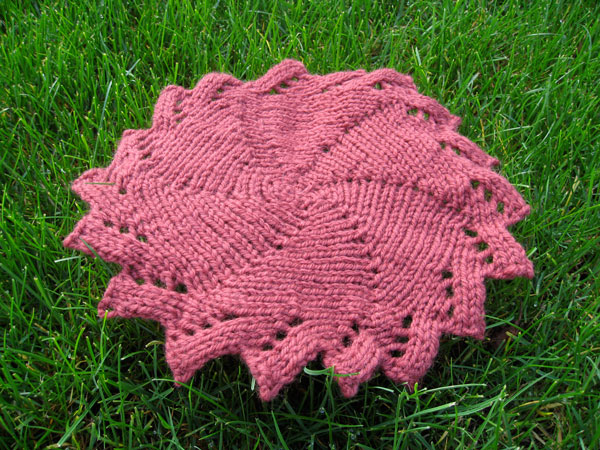
This doily was demonstrated at my local knitting machine group last fall. We were having some trouble understanding the vintage handout directions. Here’s a photo tutorial to hopefully make it clearer.
Lace Circular Doily
Depending on how big you want the doily to be, cast on 12 -18 stitches in waste yarn. Gauge or type of machine doesn’t matter much. After you’ve made one, you can increase/decrease any combination of stitches cast on, yarn thickness, tension setting, or machine gauge to make the dish rag larger or smaller.
Pick a tension appropriate for your chosen yarn. If you want to use it as a dish rag, cotton yarn is highly recommended.
This sample used 15 cast on stitches. To help keep track of the lacy increases, cast on needles 1 to 15 left of center. After a few rows are knit with waste yarn, hang a weight at each end
Remove waste yarn and insert main yarn.
RC 000
Carriage is on right to start. (COR)
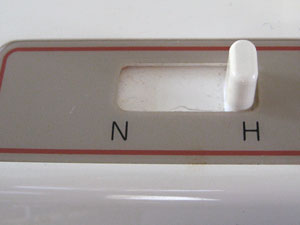 Row 1 and 2:
Put carriage to hold
 On left side, pull left most needle to hold position.
 On right side, move 3 stitches one position to the right with a three prong transfer tool.
Leave empty needle in work position.
Knit 2 rows
RC 002
COR
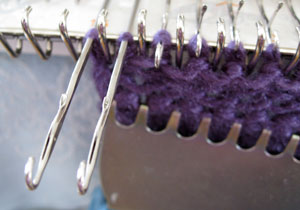 Row 3 and 4:
On left side, pull left most needle in work position to hold position.
There are now two needles in hold.
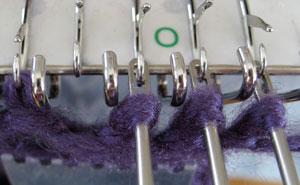 On right side, move 3 stitches one position to the right.
Leave empty needle in work position.
Knit 2 rows
RC 004
COR
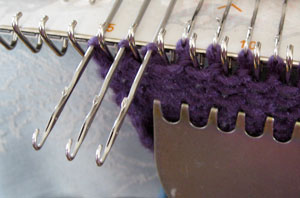 Row 5 and 6:
On left side, pull left most needle in work position to hold position.
There are now three needles in hold.
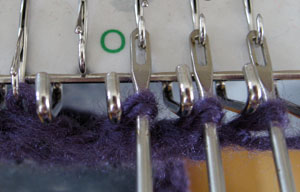 On right side, move 3 stitches one position to the right.
Leave empty needle in work position.
Knit 2 rows
RC 006
COR
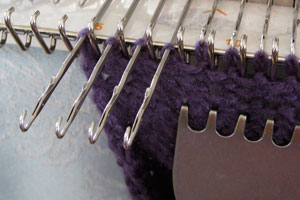 Row 7 and 8:
On left side, pull left most needle in work position to hold position.
There are now four needles in hold.
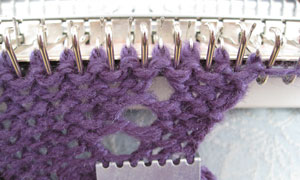 Rather than moving stitches to form more lace holes, it is now time to bind off the three stitches you’ve added on the right side.
You can double check your progress by looking at your knitting. You should see three lace holes in the current section.
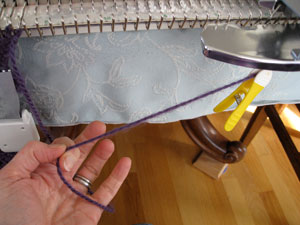 Pull out some extra yarn, holding the surplus with a clip if necessary.
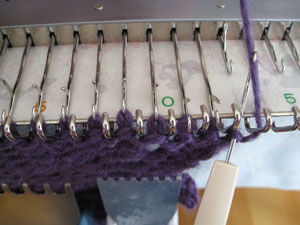 Bind off the far right 3 stitches around the gate pegs with a latch tool, moving from right to left.
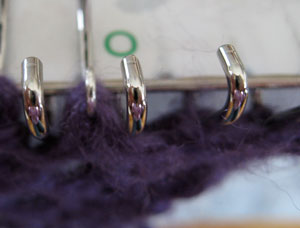 Hang the loop from your third bound off stitch to the adjacent needle. There will be two stitches on this needle.
For now, keep the bound off stitches wrapped around the gate pegs to maintain an even tension.
Knit 2 rows
RC 008
COR
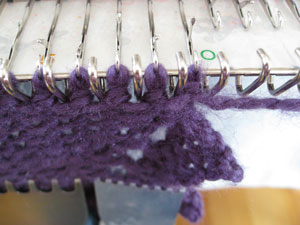 Remove the bound off three stitches from the gate pegs and let hang.
At this point you are going to continue in pattern for the lacy points while building up needles in hold on the left side until a total of 11 needles are in hold.
Row 9 and 10:
On left side, pull left most needle in work to hold position. There are now five needles in hold.
On right side, move 3 stitches one position to the right. Leave empty needle in work position.
Knit 2 rows
RC 010
COR
Row 11 and 12:
On left side, pull left most needle in work to hold position. There are now six needles in hold.
On right side, move 3 stitches one position to the right. Leave empty needle in work position.
Knit 2 rows
RC 012
COR
Row 13 and 14:
On left side, pull left most needle in work to hold position. There are now seven needles in hold.
On right side, move 3 stitches one position to the right. Leave empty needle in work position.
Knit 2 rows
RC 014
COR
Row 15 and 16:
On left side, pull left most needle in work to hold position. There are now eight needles in hold.
Bind off the three stitches you’ve added on the right side. Hang the loop from your third bound off stitch to the adjacent needle. There will be two stitches on this needle.
Knit 2 rows
RC 016
COR
Remove the bound off three stitches from the gate pegs and let hang.
Row 17 and 18:
On left side, pull left most needle in work to hold position. There are now nine needles in hold.
On right side, move 3 stitches one position to the right. Leave empty needle in work position.
Knit 2 rows
RC 018
COR
Row 19 and 20:
On left side, pull left most needle in work to hold position. There are now ten needles in hold.
On right side, move 3 stitches one position to the right. Leave empty needle in work position.
Knit 2 rows
RC 020
COR
Row 21 and 22:
On left side, pull left most needle in work to hold position. There are now eleven needles in hold.
On right side, move 3 stitches one position to the right. Leave empty needle in work position.
Knit 2 rows
RC 022
COR
Row 23 and 24:
On left side, DO NOTHING! There are still eleven needles in hold.
Bind off the three stitches you’ve added on the right side. Hang the loop from your third bound off stitch to the adjacent needle. There will be two stitches on this needle.
For now, keep the bound off stitches wrapped around the gate pegs to maintain an even tension.
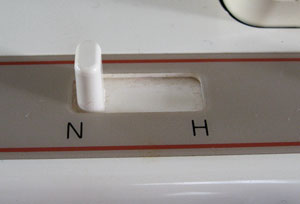 STOP!
STOP!
Take carriage off hold.
Knit 2 rows
RC 024
COR
Remove the bound off three stitches from the gate pegs and let hang.
Repeat Rows 1 to 24 until you have enough wedges to form a circle. My sample needed a total of 6 repeats of the 24 rows. Depending on how large your doily is, you may need to knit more wedges for your circle to close.
When done, Kitchner weave the two sides together.
Enjoy and Happy New Year!
Related Posts
January 2, 2012






6 comments
I appreciate the work and thought evident in the information you share. Have posted links with some of your tutorials on my own website. Thank you for your efforts and generosity.
I’ve just got my Toyota 950 out of the attic after 10 or 11 years and managed to get it all together with ribber and tilt stand thanks to this website. Now I have to learn to use it again. I bought the latest copy of Machine Knitting News – I live in Northern Ireland and was disappointed to see that patterns don’t seem to have moved on since I was knitting in the late 80’s and early 90’s. I would love to see patterns for knitted tunics/dresses which are so fashionable at the moment. Anyone out there have any patterns for waterfall sweaters or cardigans which are also very fashionable at the moment.
i think this is the cutest dish rag i ever seen! It gave me the idea of knitting a big one as a baby blanket for my new grand daughter,with an 8ply yarn on the bulky knitter (tension 3). But my maths are rather bad to say the least. Could you tell me how many needles do you think i would have to cast on?
Thank you for your help on this one and above all thank you for this great website.
You are an inspiration to everyone interested in knitting.
I have 2 knitting machines to sell . One is a Brother 930 used very little and the other is a Passap Duomatic 80 used only once and made a v necked sleevless sweater for my husband who in a year got cancer and passed away . I kinda lost interest with working and caring for a house and yard I just did not have the time and now at 84 years old I do not have the strength in my arms and hands to do it . I would sell them at a reasonable price if anyone would want to buy either or both and pay shipping to get to where they are to go. Thank you if you know of anyone . My phone number is 913-682-2987 .Both knitters have ribber s that go with them.
Very interesting. I will try these – I have hand knitted but never thought of doing them on my machine. Thank you for the great instruction and the pictures are so nice and clear.
Thank you for sharing this. Very cute and wonderful gift item idea